
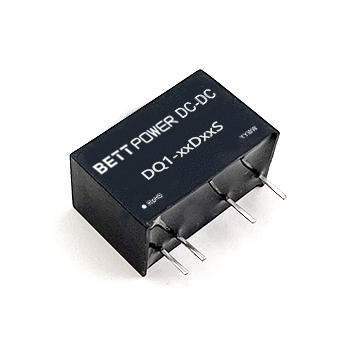

Isolated Module Power Supplies: Don’t Just Look at the Isolation Method—Isolation Voltage Is the Key Factor
Date:2026-10-13 Publisher:BettpowerIn fields such as industrial control, medical electronics, and new energy storage, isolated module power supplies serve as the core barrier for circuit safety and interference immunity. Many engineers fall into a common trap when selecting these components—they focus excessively on isolation methods such as optical, magnetic, and capacitive isolation, while neglecting the key metric that determines isolation reliability: isolation voltage.
Isolation methods are essentially means of achieving electrical isolation; they determine only the module’s transmission efficiency, immunity to interference, and cost, but cannot directly define the level of isolation protection. For example, even among magnetic isolation methods, a module’s ability to withstand high voltage can range from 1 kV to 5 kV; even if capacitive isolation is selected, it cannot meet safety requirements if there is a voltage mismatch.
Isolation voltage, however, represents the module’s protection threshold; it directly defines the maximum voltage difference that the input and output terminals can withstand over the long term, and serves as the core metric for measuring insulation strength and mitigating safety risks. It is akin to the load-bearing limit of a bridge, determining whether a module can withstand high-voltage surges and prevent insulation breakdown. Research shows that over 35% of electronic device failures stem from insufficient isolation, with the root cause being a mismatch between the isolation voltage and the application scenario.
When selecting a module, the isolation method need only match the transmission requirements: choose capacitive isolation for high-speed applications, magnetic isolation for high-power applications, and opto-isolation for low-cost applications. However, the isolation voltage must be tailored to the specific application: medical devices require reinforced isolation of 5 kV or higher to control leakage current; industrial energy storage requires isolation of 10 kV or higher to ensure safety between high- and low-voltage systems; and consumer applications require isolation of ≥1.5 kV to withstand mains power surges.
Ignoring the isolation voltage and blindly pursuing high-end isolation methods is tantamount to missing the point. Even with advanced magnetic isolation, insufficient voltage can still lead to insulation breakdown and cause failures; conversely, a moderately priced opto-isolator module can reliably achieve electrical isolation as long as the voltage is appropriate.

The core of selection is “matching requirements”: the isolation method determines efficiency and cost, while the isolation voltage determines safety and reliability. When selecting components, one should first clarify the isolation voltage level and then match it with the appropriate isolation method to avoid errors and build a robust safety barrier for electronic systems.

Tel:020-32166196
Email:info@bettpower.com
Address:Building A1, No.1 Doutang Road, Huangpu District, Guangzhou City, Guangdong Province
- Product
- AC/DC Power Module
- DC/DC Power Module
- Support
- Application
- Sample Request
 WeChat
 Sample
 Tel
Tel
 Email
Email
 TOP
TOP