
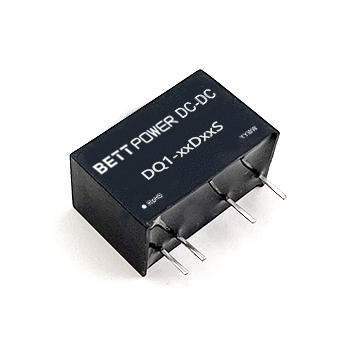

Power Module Selection for Communication Systems
Date:2026-10-14 Publisher:BettpowerCommunication equipment often operates continuously and combines multiple voltage rails, sensitive signal circuits, and increasingly compact mechanical designs. Under these conditions, selecting a power module is more than matching an input voltage with a rated output power.
A suitable module needs to match the electrical, isolation, EMC, thermal, and mechanical requirements of the complete system. The following three considerations provide a practical starting point for engineers selecting power modules for communication applications.
1. Define the Power Requirements Before Choosing a Module
Power module selection should start with the system’s actual power requirements—not simply the nominal input voltage or rated output power.
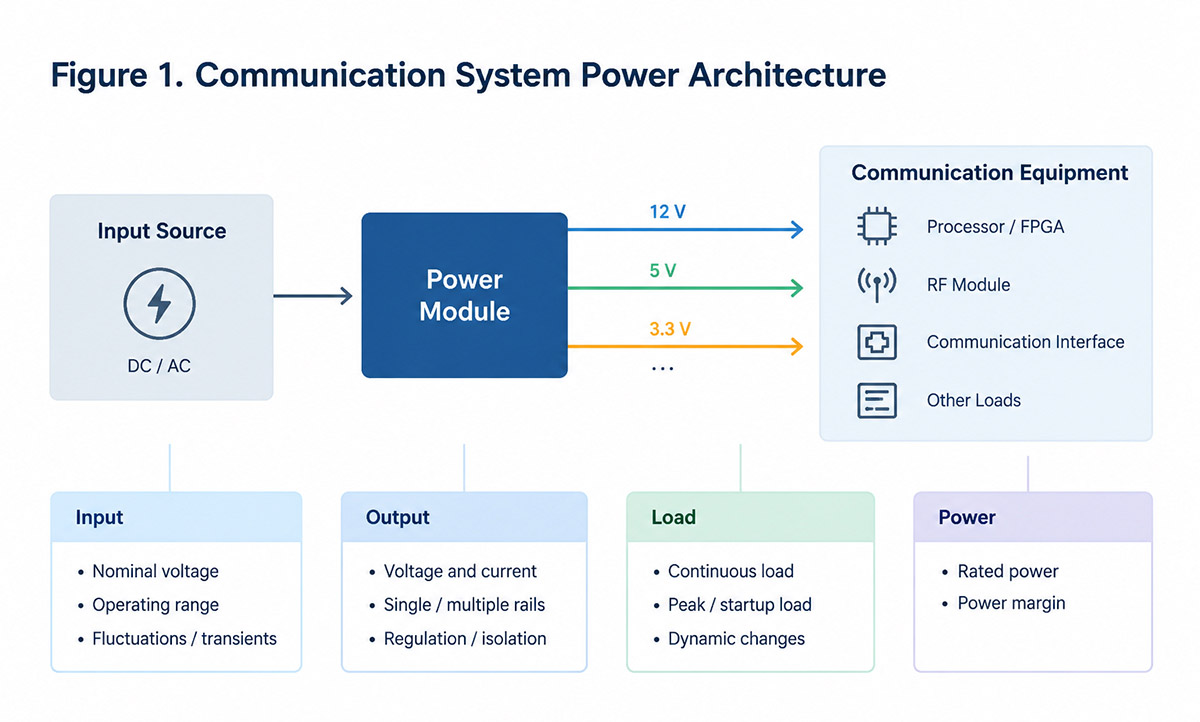
First, check the actual input voltage range, including minimum and maximum operating conditions, voltage fluctuations, and possible transients. A system specified as 24 VDC, for example, may not always operate at exactly 24 V.
Next, define the output voltage, current, and power requirements for each load. Communication equipment may require multiple voltage rails, such as 12 V, 5 V, or 3.3 V, for different functional circuits. Consider whether each rail requires independent regulation, isolation, or local point-of-load conversion.
The nominal output power can be estimated using:
Pout = Vout × Iout
However, do not select a module based only on the calculated nominal power. Peak loads, startup current, dynamic load changes, and future power requirements should also be considered. The selected module should provide sufficient power margin for the actual operating conditions.
Selection Tip: Define the complete input, output, and load conditions before selecting the module. A clear power architecture makes it easier to determine the appropriate module type, power rating, and configuration.
Figure 1. Communication System Power Architecture
2. Consider Isolation, Noise and EMC
In communication systems, power quality can directly affect signal integrity. Once the basic voltage and power requirements are defined, engineers should consider whether the power architecture provides sufficient isolation, noise control, and EMC performance for the application.
Isolation should first be evaluated based on the system’s grounding and circuit architecture. Differences in ground potential between functional blocks can create unwanted current paths or ground loops. An isolated power module can help separate these circuits and reduce unwanted coupling. This can be particularly important when powering communication interfaces, analog circuits, RF circuits, or equipment connected to external systems.
Ripple and noise should also be evaluated beyond the headline value in the datasheet. Conducted noise and common-mode noise can propagate through power and grounding paths and reach sensitive circuits. PCB layout, grounding, filtering, and the characteristics of the downstream load can therefore influence actual system performance.
Finally, consider EMC at the system level. A power module may meet its individual EMC specifications, while the final equipment can behave differently depending on the input source, load, wiring, PCB layout, and filtering.
Selection Tip: Check isolation, ripple and noise, common-mode behavior, and EMC requirements together. The right module should match the complete power and signal environment—not just its electrical ratings.
3. Evaluate Thermal and Operating Conditions
A power module may meet the required output power on paper, but its actual operating conditions also need to be considered. For communication equipment designed for continuous operation, thermal performance and derating can directly affect long-term reliability.
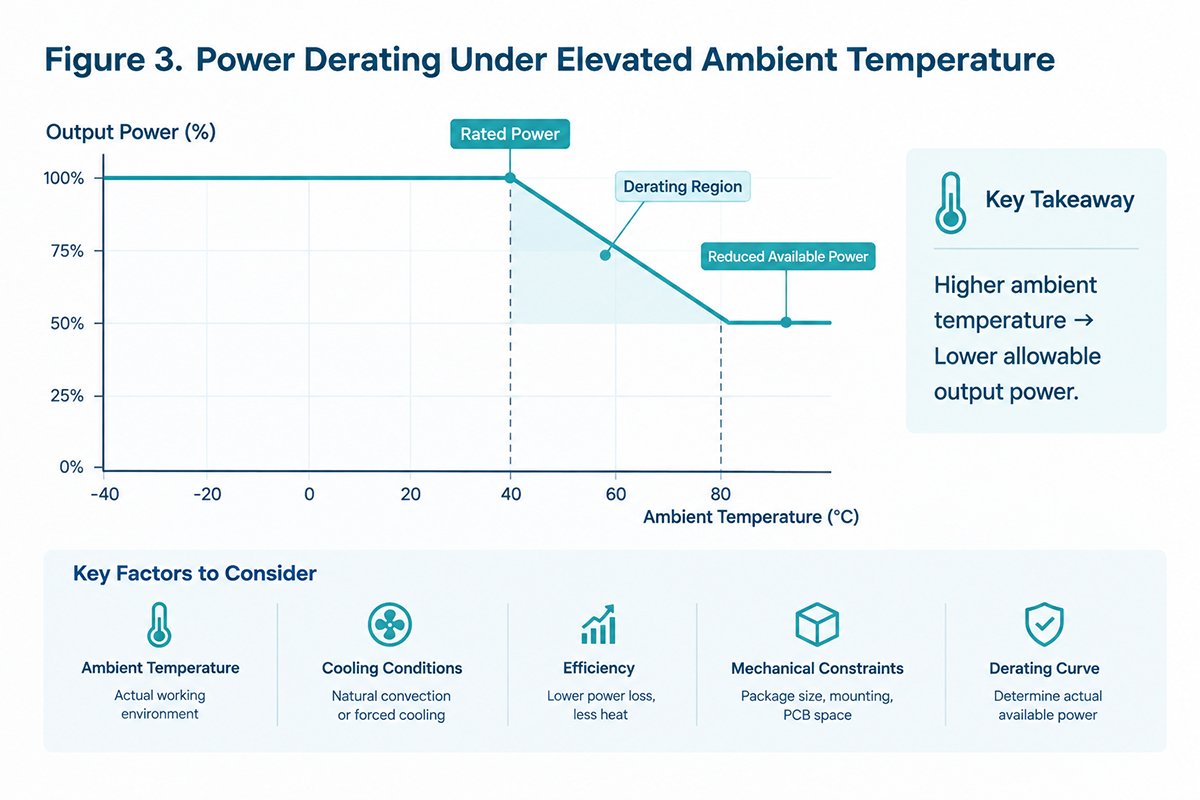
Start by checking the ambient temperature and cooling conditions of the equipment. A module operating inside a compact enclosure may experience a much higher temperature than the surrounding environment, especially when airflow is limited. Higher temperature can increase component stress and reduce the available output power.
This is why engineers should check the manufacturer’s derating curve rather than assuming that the rated power is available under all conditions. For example, a module rated at 20 W may require power derating at elevated ambient temperatures. The actual required power margin should therefore be determined based on the application’s operating temperature and cooling conditions.
Efficiency is another important consideration. Higher efficiency generally means lower power losses and less heat that needs to be dissipated. For high-density communication equipment, even a relatively small reduction in power loss can help simplify thermal management.
Mechanical conditions should also be checked before finalizing the module. Package size, mounting method, PCB space, component height, and surrounding components can all influence thermal performance and layout flexibility.
Selection Tip: Check the derating curve, ambient temperature, cooling conditions, efficiency, and package constraints together. Select the module based on the actual operating environment—not just its nominal power rating.
Figure 3. Power Derating Under Elevated Ambient Temperature
4. From Requirements to the Right Power Module
Once the electrical, isolation, EMC, and thermal requirements are defined, the next step is to match them with the right power module. A practical selection process should evaluate the module as part of the complete system rather than focusing on a single specification.
A final selection review should cover:
· Input: Does the input range cover the actual system conditions?
· Output: Does the module provide the required voltage, current, and power margin?
· Isolation: Is the isolation requirement consistent with the system architecture?
· Noise & EMC: Are ripple, noise, common-mode behavior, and EMC performance appropriate for the load?
· Thermal: Can the module deliver the required power under the actual ambient and cooling conditions?
· Mechanical: Does the package fit the available PCB space and mounting requirements?
These factors should be considered together rather than evaluated independently. A module with excellent electrical specifications may still be unsuitable if its isolation, thermal performance, or package does not fit the application.
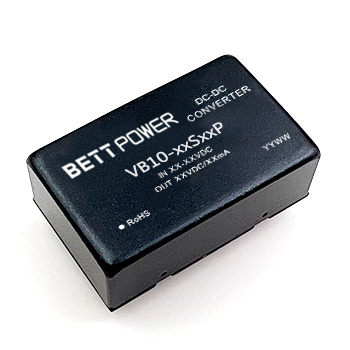
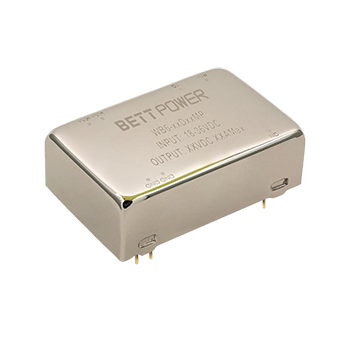
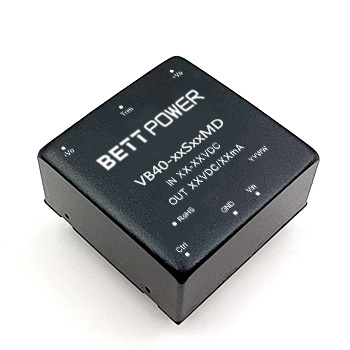
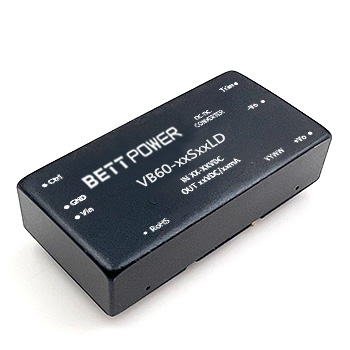
BETTPOWER provides AC-DC and DC-DC power modules covering different input ranges, output configurations, power levels, and package formats for communication and other industrial applications. By matching the module to the complete electrical, environmental, and mechanical requirements, engineers can make a more informed selection and reduce redesign risk later in the development process.

Tel:020-32166196
Email:info@bettpower.com
Address:Building A1, No.1 Doutang Road, Huangpu District, Guangzhou City, Guangdong Province
- Product
- AC/DC Power Module
- DC/DC Power Module
- Support
- Application
- Sample Request
 WeChat
 Sample
 Tel
Tel
 Email
Email
 TOP
TOP