
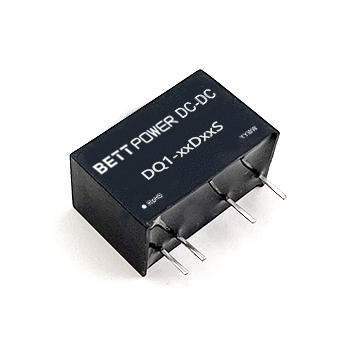

Powering Embodied Intelligence Reliable Power Architectures for Robots
Publisher:BettpowerAI is changing what robots can perceive, decide, and do. As robots become more capable, their electrical systems are becoming more complex.
A modern robot may combine AI computing, vision and sensors, motor drives, communication interfaces, and control electronics—each with different voltage, power, transient, noise, and isolation requirements.
This creates a fundamental engineering challenge:
Power can no longer be treated as a single wattage requirement.
A reliable robot power system starts with understanding the loads, builds the right architecture around them, and then selects the appropriate power solutions for each stage.
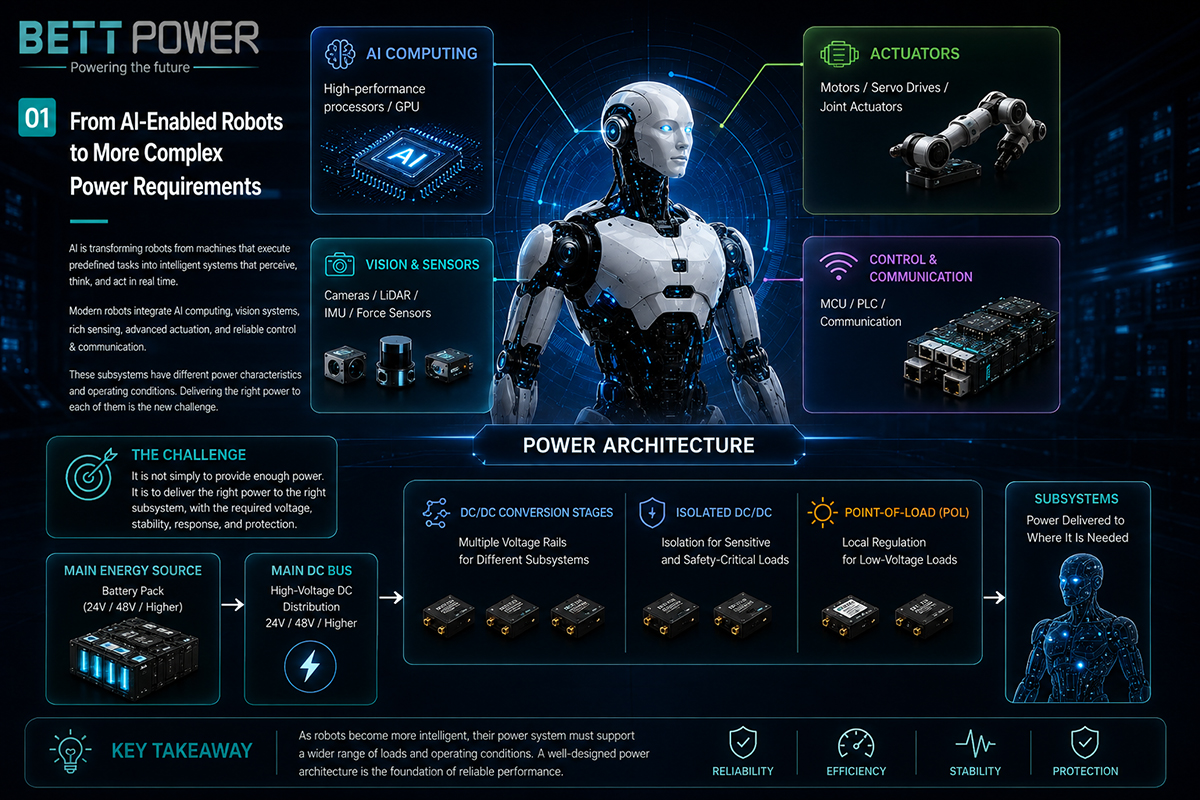
01 — From AI-Enabled Robots to More Complex Power Requirements
AI is transforming robots from machines that execute predefined tasks into intelligent systems that can perceive, process, and respond in real time.
That evolution brings new electrical demands.
AI processors require stable, high-quality power. Cameras, LiDAR, IMUs, and other sensors can be sensitive to noise. Motors and actuators can create large and rapidly changing power demands. Communication and control electronics need stable low-voltage rails.
These loads do not behave in the same way—and they should not necessarily be powered in the same way.
The challenge is therefore not simply to provide enough power.
It is to deliver the right power to the right subsystem, under the right operating conditions.
Figure 1 — From AI-Enabled Robots to More Complex Power Requirements
02 — Start With the Power Requirements
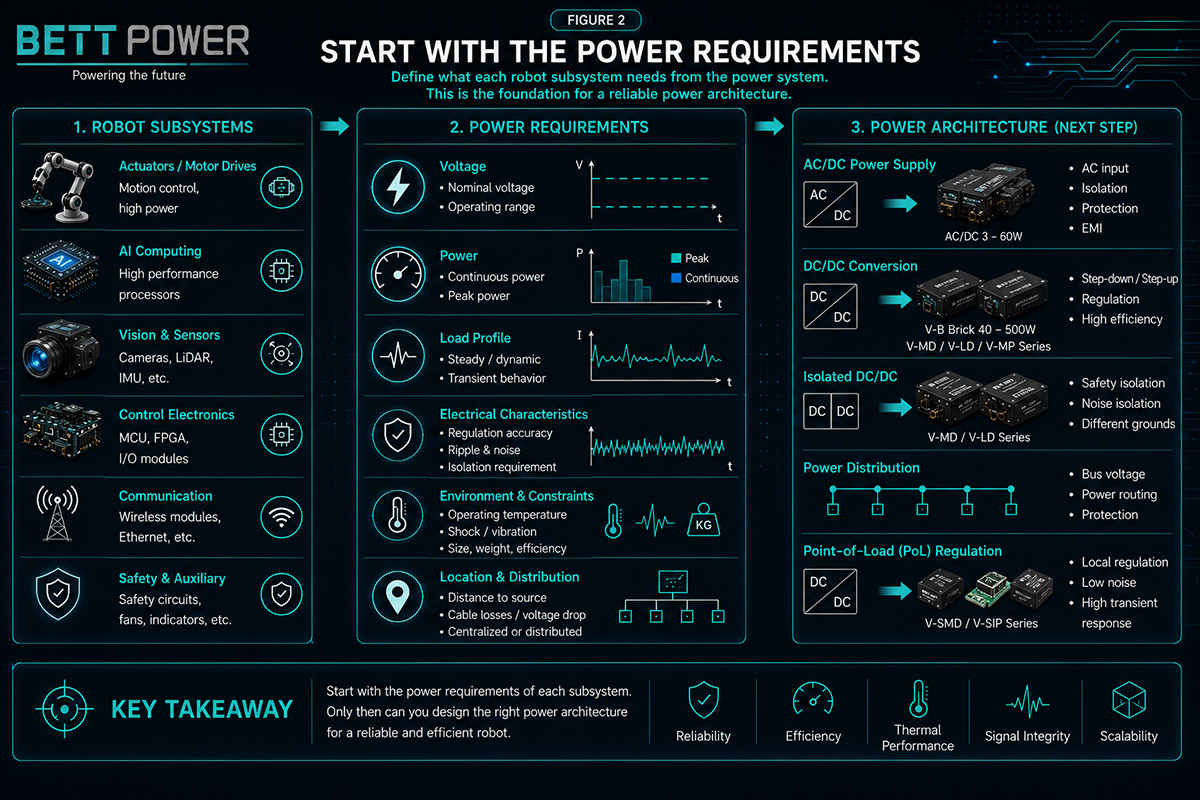
Before selecting a power supply, engineers need to understand what each subsystem actually requires.
Voltage defines the required supply level.
Power determines how much energy must be delivered.
Peak and transient demand reveal how the load behaves during acceleration, computation bursts, or other dynamic conditions.
Other characteristics can be equally important.
Regulation and noise matter for processors, sensors, and communication electronics. Isolation may be required between different electrical domains or for specific safety and system requirements.
For mobile or compact robots, efficiency, thermal performance, size, weight, and cable losses can also directly affect the overall design.
A useful first step is to map the requirements of each load:
Robot Subsystem | Key Power Considerations |
Actuators / Motor Drives | Voltage, peak current, transient response |
AI Computing | Continuous power, regulation, thermal performance |
Sensors / Vision | Low noise, regulation, isolation |
Control / Communication | Stable low-voltage rails, reliability |
System Input | Input range, protection, isolation |
The key principle is simple:
Start with the power requirements—not the power supply model.
Once these requirements are understood, engineers can determine how power should be generated, distributed, converted, and regulated.
Figure 2 — From Robot Subsystems to Power Requirements
03 — Choosing the Right Power Supply Architecture
Once the power requirements are defined, the next step is to determine how power should move through the robot.
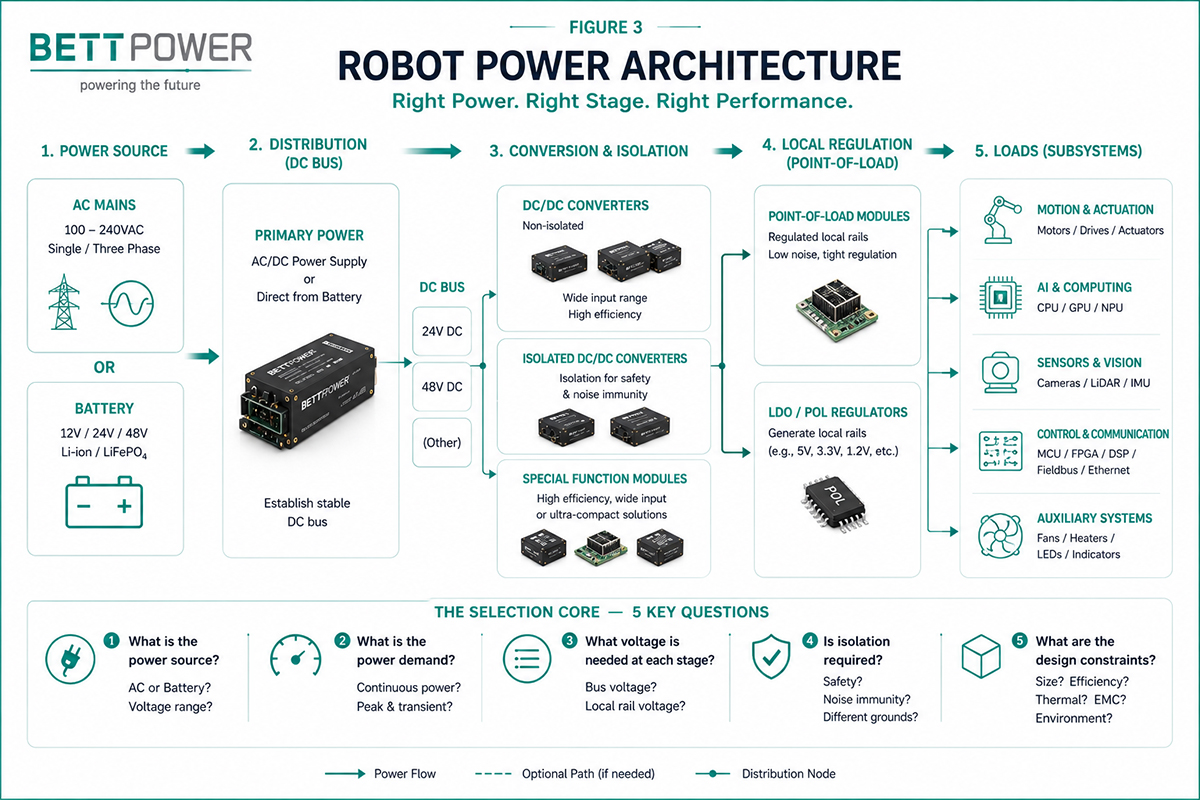
A typical power path can be viewed as:
Power Source → Main Distribution → Conversion / Isolation → Local Regulation → Load
For an AC-powered robot, an AC/DC power supply may establish the primary DC bus. For a battery-powered robot, the battery may serve as the main DC source.
The distribution voltage should be selected according to the complete system. As system power and cable distance increase, a higher distribution voltage can reduce current, cable losses, and wiring requirements. However, the choice of 24V, 48V, or another voltage should also consider safety, source characteristics, load requirements, and the operating environment.
Next, determine where conversion is actually needed.
High-power loads may connect directly to an appropriate DC bus, while processors, sensors, and control electronics may require dedicated DC/DC conversion or local regulation.
Isolation should be considered where electrical separation is required for safety, grounding, noise immunity, or sensitive interfaces.
The objective is not to add more conversion stages.
It is to create the simplest architecture that reliably satisfies the requirements of every load.
Before selecting an individual power supply, ask:
1. Where does the power come from?
AC input, battery, or another source?
2. What is the actual power demand?
Continuous, peak, and transient?
3. What voltage is required at each stage?
Main bus or local rail?
4. Where is isolation required?
For safety, grounding, noise immunity, or different electrical domains?
5. What are the design constraints?
Thermal performance, EMC, efficiency, size, weight, and environment?
The right power supply is not simply the one with enough watts. It is the one whose electrical, thermal, mechanical, and protection characteristics match the actual requirements of the load and the robot.
Figure 3 — Robot Power Architecture: The Selection Core
04 — Modular Power Solutions for Robot Systems
Once the architecture is defined, engineers can select power modules according to their role within the system.
AC/DC Modules — From AC Input to DC Power
For robots operating from an industrial AC source, an AC/DC module can provide the initial conversion from AC to DC.
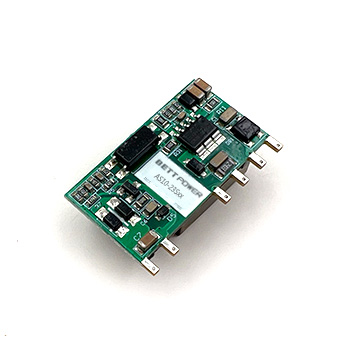
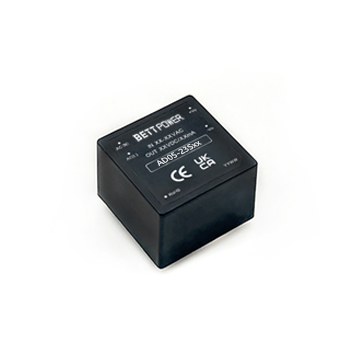
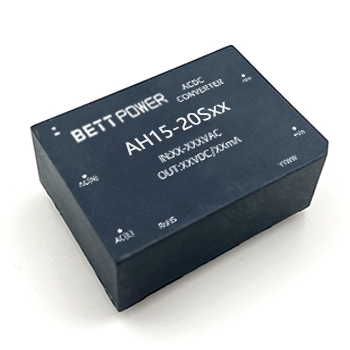
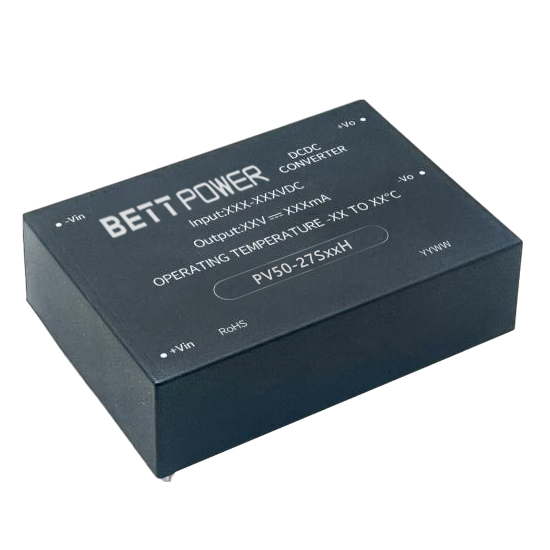
BETTPOWER offers AC/DC modules from 3W to 60W, including compact open-board and encapsulated formats for industrial electronics.
DC/DC Modules — Adapting Power to Different Loads
Once a DC bus is available, different subsystems may require different voltage levels.
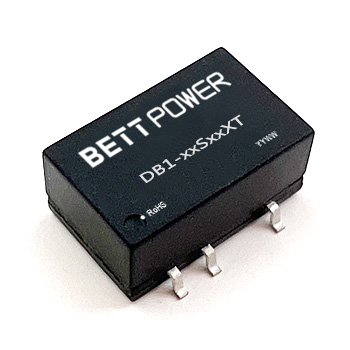
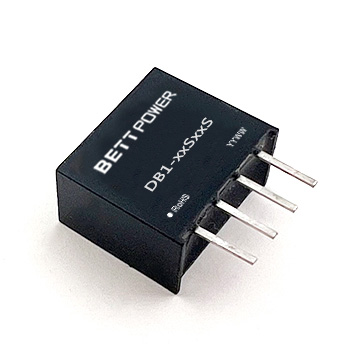
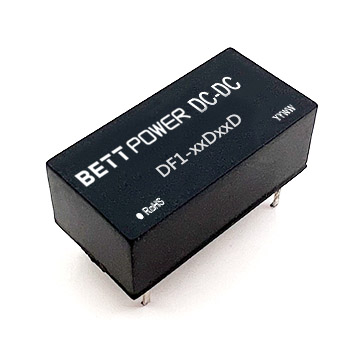
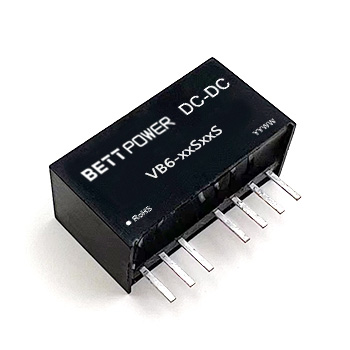
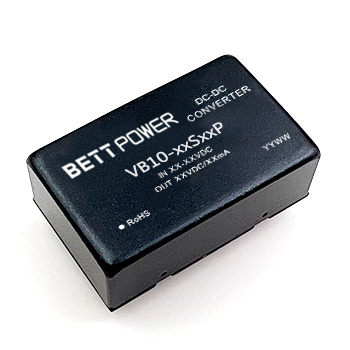
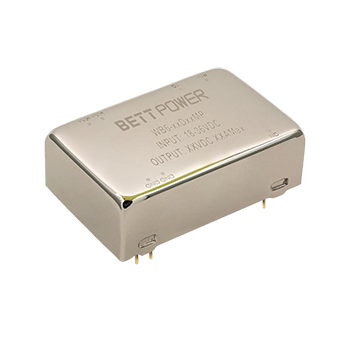
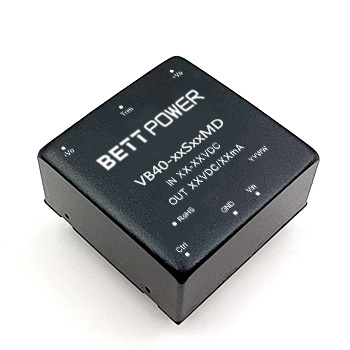
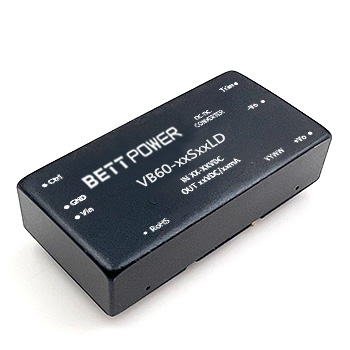
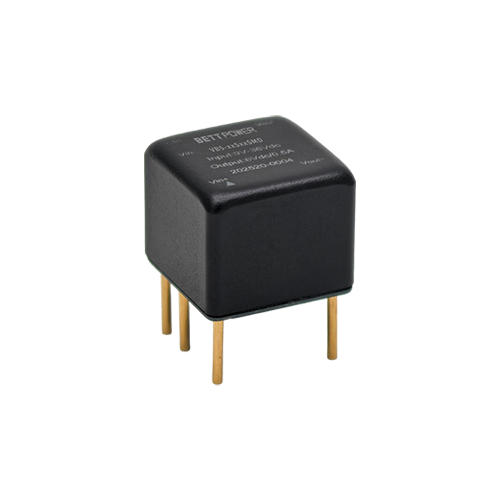
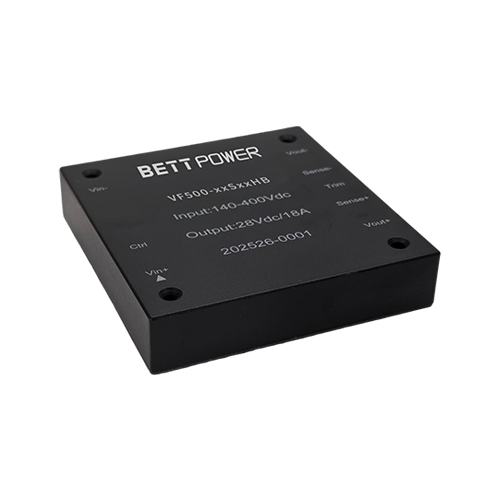
BETTPOWER's DC/DC portfolio covers 1W to 500W, including wide-input, regulated-output modules and higher-power brick-format solutions.
This range can address applications from compact control and sensing electronics to higher-power subsystem conversion.
Isolation — When Electrical Separation Matters
Where different ground domains, safety requirements, noise immunity, or system integration make electrical separation necessary, an isolated DC/DC stage can provide both voltage conversion and electrical isolation.
Isolation should be specified according to the actual system requirement rather than added by default.
Local Regulation — Power Where It Is Consumed
Processors, sensors, communication devices, and other low-voltage electronics may require tightly regulated local rails.
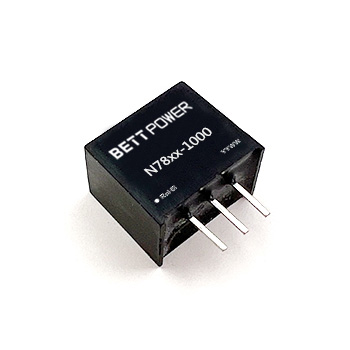
Non-isolated DC/DC modules can be useful where local conversion is more practical than distributing every low voltage across the robot.
The role of a power module is not simply to convert voltage. It is to solve a specific power-delivery requirement within the system.
05 — Design for the Robot, Not Just the Power Supply
As robots become more intelligent, their power systems are becoming more distributed, dynamic, and demanding.
A reliable power design does not start with a product number. It starts with understanding the loads, their operating behavior, and how power needs to move through the system.
The goal is not to use more power modules or simply select a higher-rated supply.
It is to deliver:
The right power.
At the right voltage.
At the right stage.
With the right level of efficiency, regulation, isolation, and protection.
For engineers developing the next generation of robotic systems, considering power architecture early can help reduce redesign, improve reliability, and provide greater flexibility as the robot evolves.
Intelligence may define what a robot can do. A well-designed power architecture helps it do so reliably.
Industrial Automation:

Tel:020-32166196
Email:info@bettpower.com
Address:Building A1, No.1 Doutang Road, Huangpu District, Guangzhou City, Guangdong Province
- Product
- AC/DC Power Module
- DC/DC Power Module
- Support
- Application
- Sample Request
 WeChat
 Sample
 Tel
Tel
 Email
Email
 TOP
TOP